Saturday, August 24, 2013

Jangle Pop from 1983


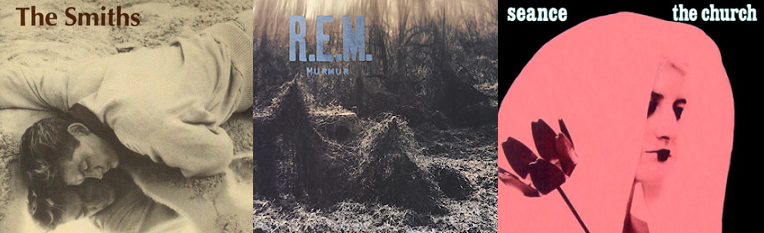
I made this playlist by seeding it with songs by R.E.M., The Smiths, and The Church and filling it up with others songs from 1983 that fit stylistically.

The Spotify playlist is here.

Southern Mark Smith - The Jazz Butcher

Radio Free Europe - R.E.M.
     Any track from Murmur could be substituted here.

This Charming Man - The Smiths

Sugar Bridge - It Will Stand - The Bluebells

Penelope Tree  - Felt

Gargoyle - The Lighthouse Keepers

Age of Consent - New Order
     I originally used this song to seed my 1983 Synth Pop playlist, but it just felt like it belonged here even though I never would consider New Order a Jangle Pop band.

One Day - The Church

Hip Hip - Hurrah

Spin Your Partner - Love Tractor
     Not much in the way of lyrics, but I love the banjo on this song.

Marilyn on a Train - The Cleaners from Venus

Second Skin - The Chameleons

Plaything - The Triffids

Whenever You're on My Mind - Marshall Crenshaw

The First Picture of You - The Lotus Eaters

Flaming Sword - Care

Beauty and Sadness - The Smithereens
  If the Beatles had recorded 'Tomorrow Never Knows' for Rubber Soul instead of Revolver.

Every Word Means No - Let's Active
    If I didn't know better, I would guess this song was actually recorded in the 60s.

Talking in My Sleep - The Rain Parade
    If Jangle Pop could be defined as "anything that sounds like The Byrds", this song would be a perfect example.

Gravity Talks - Green on Red
    I love the organ on this song.

A Million Miles Away - The Plimsouls

Numbers With Wings - The Bongos

(Let's All) Turn On - Hoodoo Gurus

In addition, these two songs weren't available for streaming on Spotify, nor are they available for purchase from Amazon mp3 download, but they definitely belong on this list:

Cattle and Cane - The Go-Betweens
    the video on YouTube

Oblivious - Aztec Camera
    the video on YouTube

appropriate comic from Overcompensating

Saturday, January 21, 2012

10 Year Anniversary


On January 21, 2002, NetFlix mailed me my first three discs (Brazil, Girlfight, and Sex in the City). Today, they mailed me my 1,175th disc (Toy Story 3).

Originally, NetFlix seemed (and was) forward thinking for it's innovative use of new technology and inventing a service most people didn't even realize they wanted. It seems strange now, that technology has made both DVDs and The Postal Service less relevant.

But I suspect I'll remain a loyal subscriber until the DVD by Mail service is as much a relic as the nickelodeon or the video rental store.

Thursday, March 31, 2011

Top 3 Directors of 1931


3. Fritz Lang


2. James Whale


1. René Clair

Saturday, August 14, 2010

The Shining

The opening scene is a small car driving on a curvy mountain road as seen from a helicopter. This match-cuts to long shots of characters moving through the cavernous rooms of a hotel as seen from a steadi-cam that is moving at the approximate relative speed as the helicopter. The effect is dwarfing; the character we're following is a small man in big world he can't control. He's there to interview for a job as a caretaker for a hotel that's closed and isolated from civilization over the harsh winters. He's a writer that plans to spend the winter there with his wife and son and use the isolation to focus on his writing.

While there, he goes a little crazy from the isolation (and perhaps the ghosts).

Director Stanley Kubrick maintains unnerving balances between sanity and madness, and between the real and the supernatural. The writer, Jack (played by Jack Nicholson) seems a little off even at his most sane, making it difficult to tell exactly when he becomes unhinged. Although there are definitely supernatural elements - the son, Danny, and the hotel cook (played by Scatman Cruthers) can communicate telepathically, and Danny has visions of the hotel's violent history - it's not entirely clear whether there are actually ghosts, or if these ghosts can physically harm anyone. Somebody does rip Danny's sweater, and somebody does unlock a door or two, but we never actually see these things happen. Every time Jack holds a conversation with a ghost, there's a mirror or reflective surface in front of him - might he actually be talking to himself?

Unlike other horror movies, the characters actually behave in a ways that real people might if they were in a similar situation - they make smart, well-reasoned decisions in their attempts to escape from harm. Also unlike other horror movies, the tension ratchets up higher than the body count. The Shining is a rare horror movie that stays with you for days after you've seen it, and is as frightening today as was 30 years ago.

Friday, August 13, 2010

Friday the 13th

It's easy to understand why a formula would start to get stale after a dozen sequels, but how did they manage to make it seem so tired the first time out? The trailer tells you what to expect: 8 teenagers are isolated alone in the woods while an unknown psycho murders them one by one. The movie meets that expectation, and nothing more.

Perhaps if the characters had been interesting, I would have cared about whatever it was they were doing before they got killed, but they are all amiable-but-bland samey-looking stiffly-acted teenagers. Only one is given a personality - Ned, the goofy prankster - but it's such an annoying personality that I found myself hoping he would be the first one offed. I assumed the pranks were introduced to set up some misdirection and I waited for an actual death to be laughed off as a prank or a faked death to be mistaken for a real one, but nothing ever came of it. There're no interesting characters, no misdirection, just 8 kids getting murdered one by one, and nothing more.

I also hoped that there would be some mystery. Who was this killer? Was it someone we met? It seemed like they wanted to throw in some red herrings: The camp boss leaves the camp just before the teenagers start to die, maybe it's him? No, the very next scene establishes that the killer is driving a jeep different from the one the boss drove out on. The town crazy shows up at camp shouting that they are all doomed, maybe it's him? No, we see him in the very next scene getting away on a bicycle, not a jeep. Maybe one of the kids is actually the killer? No, the very first kill happens far away from any of them establishing all their alibis. There's no mystery to figure out, just 8 kids getting murdered one by one, and nothing more.

Strangely, nobody even realizes there's a psycho killer on the loose until moments before they're killed. The last two alive are the first to suspect something's happening when they can't find their friends, but nobody ever witnessed a murder or found a body until there was only one left alive. It wasn't 8 kids trying to outwit a psycho killer in the wilderness, it was just 8 kids getting murdered one by one, and nothing more (well, maybe the last one was trying to outwit a psycho killer).

The movie even fails at being just a shameless excuse to show nudity and gore. Only one couple has a very tame sex scene were very little is exposed. The others engage in a very PG game of strip Monopoly that ends before they get very far. There are two or three gruesome images, but half the murders take place off-screen.

There was only one scene that gave me a genuine fright. It was a tacked on bit at the end, and even though I'd seen the movie before and knew what was about to happen, it still got me. But one well-executed scene doesn't justify the rest of the surprisingly boring, mostly un-scary movie. It certainly doesn't justify its dozen sequels.

Saturday, July 31, 2010

1. Van Morrison - Moondance

Counting down my favorite 25 albums of 1970:

Van Morrison - Moondance


Van Morrison must have been in a fantastic mood when he produced this album - it's the most comfortable album ever recorded.

Stylistically, the songs on this album have a wide range of moods and genres (blues, jazz, country, folk, rock), but thematically, they all address the warmest, most natural, most universal human experiences: nostalgia for carefree youth ('And It Stoned Me'), the buzz of good times with good friends ('Moondance'), the giddiness of a new infatuation ('Crazy Love'), the sense of security and validation that comes with camaraderie ('Caravan'), the rapture you feel in the awesomeness of nature and your place in it ('Into the Mystic'), etc.

The Moondance vs. Astral Weeks debate divides Van Morrison fans. The critical concensus is that Astral Weeks is Van Morrison's best album; Acclaimed Music ranks Astral Weeks as the #15 album of all time with Moondance at #95. I'm in the Moondance camp. My defense is that the emotions this album evokes are so primal, so visceral, that it doesn't pose much challenge to the listener - it's simply not humanly possible to dislike this album. I suspect this makes the album seem slight or vapid, but this is deceptive; It's not as easy as it looks to make it look this easy.

Friday, July 30, 2010

2. Crosby, Stills, Nash & Young - Déjà Vu

Counting down my favorite 25 albums of 1970:

Crosby, Stills, Nash & Young - Déjà Vu


This album, their first (with Young), was highly anticipated and was a commercial and critical success. Each of the four contributed two songs each plus an additional Stills/Young collaboration (the closer 'Everybody I Love You'), and the Joni Mitchell cover 'Woodstock'.

They provide the vocal harmonies and signature sound their fans expect on the opening track 'Carry On', but they also expand their sound and appeal with the country-influenced 'Teach Your Children' and the Beatlesque pop of 'Our House'. By the end of the album, they give an indication of the direction they're heading; Stephen Stills' '4 + 20' sounds like the mellow blues songs he would explore on his first solo album later in the year, and Neil Young's 'Country Girl' suite would fit right in with the rest of his moody minor-key ballads on his After the Goldrush album.

1970 was definitely CSN&Y's year. A few months after the release of this album, they would record and release the classic song 'Ohio' inspired by and released a few weeks after the Kent State shootings. A few months after that, the concert film for the Woodstock Festival and the soundtrack on which they are prominently featured would be released. By the end of the year, both Stephen Stills and Neil Young would release excellent solo albums.

Thursday, July 29, 2010

3. Santana - Abraxas

Counting down my favorite 25 albums of 1970:

Santana - Abraxas


It's hard to imagine another era in the history of popular music where the prog-rock experimentation of Pink Floyd, the electric guitar idolatry of Eric Clapton, the world-beat exoticism of Ravi Shankar, and the jazz-rock fusion of Miles Davis could co-exist so comfortably in someone's LP collection. It's particularly hard to imagine another era when all these influences would co-exist on a single album.

Wednesday, July 28, 2010

4. John Lennon - Plastic Ono Band

Counting down my favorite 25 albums of 1970:

John Lennon - Plastic Ono Band


John Lennon had released personal songs before before ('The Ballad of John and Yoko' and 'Cold Turkey' for example), but this album goes further; it's a therapeutic exercise where he lays bare all his neuroses and insecurities for examination and exorcism. It's almost as if he never intended an audience to listen to it; he doesn't seem to be trying to make any of it commercially appealing, or to conceal anything that might be embarrassing or reveal his vulnerabilities.

Because of it's unique nature, most of the tracks really don't stand alone out of context ('Working Class Hero' is an exception), but there's not one track on the album that shouldn't be there. The album as a whole is greater than the sum of its parts.

Tuesday, July 27, 2010

5. Nick Drake - Bryter Layter

Counting down my favorite 25 albums of 1970:

Nick Drake - Bryter Layter


This album was a late bloomer. It started turning up on critics top ten lists and movie soundtracks in the 90's, but seems to have been more or less ignored when it was released in 1970 (basically the opposite of what happened with The Pretty Things' Parachute).

The album doesn't sound much like it's contemporaries. Richard Thompson and John Cale show up on the album, and their influence is recognizable, but the folk elements are more polished than the ramshackle style of Fairport Convention, and the art rock is more mannered and classical-leaning than the rougher sound of Velvet Underground. There's is also a distinct jazz influence - most notably on the fantastic 'Poor Boy'. I'm also a fan of the string arrangements on several of the tracks and the brass arrangement on 'Hazey Jane II', all arranged by Robert Kirby (I'm making a note to check out other albums he's worked on).

Monday, July 26, 2010

6. The Pretty Things - Parachute

Counting down my favorite 25 albums of 1970:

Pretty Things - Parachute


This album is made up of hard rockers with a bitter edge ('Cries From The Midnight Circus' and 'Sickle Clowns') tempered with sweet ballads featuring lovely three part harmonies ('The Good Mr. Square'). The result is a multi-textured, but cohesive collection of great songs that ends up sounding like a hard rock Abbey Road.

The album was well-regarded by critics at the time; Rolling Stone named it the best album of the year. It's a mystery to me why it has faded into relative obscurity since. Perhaps it's because the album didn't produce any tracks that have become staples of classic rock radio, or because The Pretty Things subsequent work didn't live up to the promise of this album.

Sunday, July 25, 2010

7. Dave Mason - Alone Together

Counting down my favorite 25 albums of 1970:

Dave Mason - Alone Together


Along with George Harrison and Sandy Denny, Dave Mason contributed to a trend of under-appreciated sidemen that made striking solo debuts in 1970. This album, his first post-Traffic effort, is a model of economy: 8 tracks, 34 minutes, no filler, no throw-away tracks, no overlong solos. Each track is a solid original pop song that could stand alone as a single. He has an almost McCartney-esque knack for making pop songwriting look easy, whether it's a rocker like or 'Only You Know and I Know' or a sentimental ballad like 'Sad and Deep As You'.

Saturday, July 24, 2010

8. Cat Stevens - Tea for the Tillerman

Counting down my favorite 25 albums of 1970:

Cat Stevens - Tea for the Tillerman


The exploration of spiritual topics wasn't uncommon or unpopular at the time this album was released, but I can't think of any other artist that made his personal spiritual journey so central to his artistic identity. His spirituality is not the primary appeal to me, but I do appreciate that his lyrics are intellectually inquisitive, and not pedantic or trite. If there's one song with a whiff of sanctimony, it's 'On The Road To Find Out', but the song is so rockin' that it's easy to overlook the preachiness. That's what really makes the album great; every song is catchy and interesting. Stevens never forgets that he's a pop star not a priest.

Friday, July 23, 2010

9. The Beatles - Let It Be

Counting down my favorite 25 albums of 1970:

The Beatles - Let It Be


This album is much better than it has a right to be. Its troubled history is well documented: In early 1969, The Beatles decided to 'Get Back' to their roots and make an album in the style of their early albums, and to have film cameras document whatever happens - unfortunately, not much did. By the time the sessions dissolved, there were hours of film footage and audio tape of the Beatles tuning guitars, warming up with classic rock covers, and getting testy with each other. The project was abandoned, and only two singles 'Get Back' and 'Don't Let Me Down' were salvaged from it.

In 1970, Phil Specter was hired to make an album out of the mess. It would be the first Beatles' album not produced by George Martin, and Specter's 'wall of sound' production style didn't seem like a natural fit for the album's back-to-basics concept. Anyone who had heard the widely circulated 'Get Back' bootleg album that was generated from these sessions (which was also not produced by George Martin) would not have high expectations of this Specter-ized version.

Incredibly, the album is fantastic. Even the criticism of Phil Specter's overblown production on 'Long and Winding Road' seems unfair - could the song really be less sappy even without the choir of angels? The in-between-songs banter, and the loose and joyful mood really show through as originally intended; this is particularly remarkable considering the actual mood of the sessions (if the footage in the film is any indication) was often tense and joyless.

A particular highlight for me is the song 'I've Got a Feeling'. My favorite Beatles' songs are the ones where an unfinished McCartney song is mashed up with a complementary unfinished Lennon song (The earliest example being the appropriately titled 'We Can Work It Out' in 1965; Sgt. Pepper's 'A Day in the Life' is another memorable example). McCartney's 'I've Got A Feeling' shifts into Lennon's 'Everybody Had a Hard Year' and back again.

This is not the first or only time that Phil Specter was involved with the Beatles in 1970. He first produced the single 'Instant Karma' for John Lennon (easily my favorite song of 1970), and he also produced George Harrison's excellent solo album All Things Must Pass.

Thursday, July 22, 2010

10. Joni Mitchell - Ladies of the Canyon

Counting down my favorite 25 albums of 1970:

Joni Mitchell - Ladies of the Canyon


This one is a grower. On first listen, it's a pleasant and pretty folk album with the tone set on the folksy opening track, 'Morning Morgantown', with the fun 'Big Yellow Taxi' standing out near the end. After listening to it several times, I found the other tracks beginning to sink in. I was really hooked by the complex arrangements with a variety of instruments (the flutes in 'For Free', and the piano in several tracks) and her expressive vocals that tap into some authentic emotions not typically expressed in pop songs (the sympathetic jealousy in 'The Conversation' stands out to me).

It's 'Woodstock' that really gets me, though; the Crosby, Stills, Nash, and Young's cover was louder, more muscular, and more popular - and a fantastic interpretation to be sure - but Mitchell's own version of her song is intimate and soulful with effective non-lyric vocal sections and instrumental sections that highlight the song's haunting piano arrangement.

Wednesday, July 21, 2010

11. James Taylor - Sweet Baby James

Counting down my favorite 25 albums of 1970:

James Taylor - Sweet Baby James


I was familiar with the song 'Fire and Rain' before I ever listened to this album, so I had an idea of what to expect - smart, mellow, minor-key folk rock with enough of a melancholy edge to not be sappy. The album provides exactly that ('Sunny Skies' is an apt example), but this is not a follow-your-formula kind of album; it's more of a jazz-like riffing on a theme.

Without straying too far from his comfort zone, Taylor explores a variety of genres: the country waltz lullabye of 'Sweet Baby James', the bluesy 'Steamroller', the gospel 'Lo and Behold', and the vocal improvisation in 'Oh Susanna'. The final track, 'Suite for 20G', is a multi-textured combination of several of these elements, and it's a perfect, if disjointed, culmination of the tracks that precede it.

Tuesday, July 20, 2010

12. Creedence Clearwater Revival - Cosmo's Factory

Counting down my favorite 25 albums of 1970:

Creedence Clearwater Revival - Cosmo's Factory


This is CCR's 42 minute clinic on rock and roll music - it's history, and it's influence on the then current incarnation of the genre. For comparison sake, they provide two covers of classic rock songs ('Ooby Dooby' and 'My Baby Left Me') faithfully interpreted in the style favored in the last half of the fifties by the likes of Chuck Berry and Elvis Presley. They also provide two originals performed the same way ('Travelin' Band' and 'Lookin' Out My Back Door'), to show that the genre is durable. To prove the genre is flexible as well, they perform two additional covers in styles popular with their contemporaries: a rocking cover of a blues standard ('Before You Accuse Me'), and an epic length meandering rock jam ('I Heard it Through the Grapevine').

If there's one track that best exemplifies the band's authority on rock and roll, it's 'Ramble Tamble', the first song on the album. One critic (Steven Hyden from The Onion's AV Club) makes a convincing case for this song being the 'Most Rockin' Song of All Time'.

The album does have a few notable departures from its prevailing roots rock theme: the socially conscious folk rock song 'Who'll Stop the Rain', the menacing bayou blues of 'Run Through the Jungle', and the soulful "Long As I Can See the Light".

Monday, July 19, 2010

13. Simon and Garfunkel - Bridge Over Troubled Water

Counting down my favorite 25 albums of 1970:

Simon and Garfunkel - Bridge Over Troubled Water


I find this a very difficult album to rate. It's one of the first albums I ever owned, and the first album I ever memorized all the lyrics to. It's probably the one non-Beatles album I've listened to most frequently, and I haven't grown tired of it yet.

This familiarity makes it difficult for me to be objective. On one hand, it's easy to overrate songs like "Baby Driver" and "Why Don't You Write Me" simply because I know them so well. On the other hand, the sheer repetition makes it easy to forget that songs like "Bridge Over Troubled Water" and "The Boxer" were once fresh.

In its cultural context, it was a phenomenally successful record: It's one of the best selling albums of the year, it spawned four hit singles, and it won the Grammy for best album. The fact that this album appealed to so many different people during such a culturally divisive era is an incredible feat. This broad appeal is, I think, attributable to it's timelessness; both thematically (no questions about what war is good for or references to Woodstock or tin soldiers and Nixon), and musically (no long jammy electric guitar solos or sitars). Ultimately, This album may sound "old" due to its constant radio airplay, but it doesn't sound "dated".

Sunday, July 18, 2010

14. The Kinks - Lola versus Powerman and the Moneygoround, Part One

Counting down my favorite 25 albums of 1970:

The Kinks - Lola versus Powerman and the Moneygoround, Part One


I seems that every third song on this album is a Ray Davies' satire about the treachery of the music industry. If his lyrics weren't so clever and his music so catchy, it would sound pitiful. Fortunately, these songs are endearing enough not to distract from the rest of the album - which rocks. Some of my favorites: the crunchy "Rats", the sweet "This Time Tomorrow", the fun "Ape Man", and the acoustic-but-hard "Lola".

Saturday, July 17, 2010

15. Fotheringay - Fotheringay

Counting down my favorite 25 albums of 1970:

Fotheringay - Fotheringay


Sandy Denny's first project after leaving Fairport Convention consists mostly of her singing original ballads that sound like they could be traditional folk songs, plus a handful of actual traditional folk songs sung by guitarist Trevor Lucas. The album is at its best when it features Denny's ethereal vocals over a rolling cadence of syncopated bass-heavy guitars. Still, the hypnotizing Gordon Lightfoot cover "The Way I Feel" featuring Lucas on vocals has ended up on many of my playlists.

It's a wonder that this album wasn't more popular. Perhaps fans were expecting the looser, more ragged sound of Fairport Convention and found the classical perfectionism to be stifling. Maybe if the album had been directed to Joni Mitchell or Tim Buckley fans, it would have found a more appreciative audience.